"Working with a woman today who suffered a major fire loss with a mass-market carrier. Her home was insured for just over $1 million when it should have been nearly $3 million. The six figure amount she has been paid was just for replacing the basement, renovating some of the interior, and the damaged furniture."
– Denise Koslowsky, Principal, Advocate Brokerage Corp.
"A client had a massmarket carrier. I moved him to a HNW-market carrier. Soon thereafter, a windstorm pushed a tree through his home. The HNW carrier paid for the windows to be hand blown to match the original windows, while the neighbor had to accept stock windows that did not match the rest of the home."
– Chris Chatfield, Director, Private Client Group, Kemmons Wilson Insurance Agency
Also, standard policies will often not pay for losses due to breaks or fractures of fragile items if, for instance, a precious statue or vase is accidentally knocked over. Such losses are typically covered by policies from HNW-market carriers.
These carriers also provide the ability to cover groups of items, such as a wine or art collection, on a blanket basis in which an overall coverage amount is set for the group. This approach eliminates the tedium of trying to estimate the value of each individual item, and makes the overall policy easier to manage.
Differences exist beyond coverage. HNW-market carriers will often bring in experts to suggest safety measures, such as a backup generator to keep a temperature-controlled wine cellar operating during a sustained power outage. They may also be able to assist in the evacuation of precious items from homes caught in the path of a hurricane.
The main home and any vacation homes often represent a significant, if not the largest, component of a family's net worth. Therefore, having the proper coverage in the homeowners policy is critical to a wealth protection plan.
Nevertheless, after almost every natural disaster, news stories describe families who have discovered they lack sufficient insurance to rebuild their home. According to a study conducted by United Policyholders one year after the 2010 Fourmile Canyon Wildfire in Colorado, 64 percent of respondents who lost their homes reported being underinsured by an average of $200,000. In a similar study by the organization two years after a series of 2007 California wildfires, 66 percent reported being underinsured by an average of more than $319,000.7
These disturbing numbers parallel the findings of MSB, a leading worldwide provider of building cost data and estimating technology for the property insurance industry. Its 2012 study estimated that 61 percent of American homes are undervalued for the purpose of insurance.8
For owners of custom-built or historic homes, the problem may be worse, especially if they insure their home with a mass-market policy. Standard industry tools that estimate the cost of rebuilding a home can undervalue the higher quality materials, superior craftsmanship, and unique architectural features in these types of homes. Furthermore, the owners may have expanded the size of the home or built a lavish entertainment center in the basement. Like most people, they forget to tell their insurance agent.
These homeowners should secure full replacement cost coverage (also called guaranteed replacement cost coverage) for the home structure. Available in all but a few states, this coverage will usually pay to rebuild the home with similar quality materials and craftsmanship, even if the cost exceeds the coverage limit in the insurance policy. In effect, this coverage shifts the responsibility for properly estimating the cost of replacing the home from the family and insurance agent to the insurance company. Therefore, the carriers will often send an expert to the home to document its features and estimate the replacement cost. The visit also gives the expert a chance to suggest ideas for better protecting the family and the home.
By contrast, mass-market policies typically offer basic replacement cost or extended replacement cost coverage. The former will pay to rebuild a damaged home up to the coverage limit in the policy. The latter will usually extend the amount it will pay up to 20- 25 percent above the coverage. As the real-life disaster stories illustrate, even the extended replacement cost coverage might not make up for the shortfall.

"A client in a large luxury condo with a valuable art collection had a water damage loss with a policy from a mass-market carrier. Had less than $200,000 of contents / additions & alterations and no fine arts schedule. The loss exceeded $1 million. We insured with coverage limits in the millions for contents and additions & alterations, as well as $25 million for fine arts."
– Bibi Karim, SVP & Manager, Private Client Services, Wells Fargo Insurance Services
"A client had a jewelry item insured for $85,000 and the massmarket carrier at the time of loss said they could replace the item for $55,000. When the client demanded to use their own jewelry store, they only received a check for $55,000 and lost $30,000. As a result, they moved all their insurance over to us and have been clients for over 12 years."
– Dana Conner, AVP, BB&T Insurance Services
Families with substantial assets often hold a significant portion of their total wealth in jewelry, art, wine and other valuable collections. In an ACE study about collections among households with at least $5 million in investable assets, 94 percent claimed to be collectors.5 Of those, 69 percent had collections worth $500,000 or more, including 21 percent with collections worth more than $5 million. Furthermore, 55 percent planned to increase their spending on their collections over the next 12 months. According to a 2012 Barclays report, high net worth individuals in the U.S. hold an average of 9 percent of their wealth in collectibles.6
While collectors may go to great lengths to acquire the items they desire, they frequently fail to adequately protect them. Fully 86 percent of agents said the families probably had their collections inadequately insured. The lapse stems mainly from three factors:
 Crude tracking and valuation:
Insuring a collection properly starts with knowing what you have and how much it would cost to replace. Too often, collectors fail this task. Many use simple spreadsheets that cannot easily capture and organize supporting documents such as photos, bills of sale, and formal appraisals. They may also fail to track the current market value of their collections. In the ACE collections study, one in three was not updating the market value of his or her collection every three years. That is not often enough, considering the significant shifts that have been occurring in the market value of gold, silver, art and other types of collectible items.
Homeowners insurance limitations:Collectors may not realize that homeowners policies restrict coverage for jewelry, silverware, furs, stamp and coin collections, and breakage of fragile items such as marble statues, musical instruments, and bottles of fine wine. In standard policies, the coverage limits may equal only $1,000 or $2,000. Policies from HNW-market carriers contain higher limits, but they exist nonetheless.
Poor loss prevention:Many collectors display or store their precious possessions in ways that increase the risk of damage or theft. For instance, they hang artwork above an active fireplace, where the hot, dry air and soot accelerates deterioration. Or, they store a valuable stamp collection in a closet beneath a bathroom. If the tub overflows or the toilet develops a leak, the stamps could be ruined. A professional risk consultant can help collectors avoid these mistakes, but 40 percent of collectors do not take advantage of this service, according to the ACE collections study.
To gain the best protection, families should seek the added protection of a valuables policy for their collections. Often known as scheduling an item or adding a homeowners policy rider, a valuables policy allows the collector to declare the value of each piece, or group of pieces, on the policy. This valuation is not restricted by the limits in the homeowner policy, and the coverage applies to all types of perils, including those excluded by homeowners policies such as flood. Also, no deductible applies.
Policies from HNW-market carriers have additional advantages. They provide a buffer against temporary fluctuations in the replacement cost of valuables articles by paying market value up to 50 percent higher than the scheduled amount of coverage in case of loss. Standard policies do not. In fact, some may pay even less than the scheduled amount if an actual cash value clause is in effect.

During a party at a hillside home, many guests were injured when the overcrowded deck collapsed. The medical costs quickly exceeded the host's liability coverage.
The danger from the uninsured and underinsured goes beyond auto accidents. Consider a child flying off a neighbor's trampoline and suffering a permanent brain injury requiring lifelong care. The expenses for medical treatment and care could amount to millions of dollars. But most homeowners have no more than $300,000 to $500,000 in liability coverage.
Without the additional protection, families can be forced to sacrifice their homes, their savings and investments, and their future income stream to pay damages. These dire consequences explain why agents ranked umbrella liability as the most serious problem of underinsurance. Fully 40 percent of agents gave it the top spot, more than for any other type of coverage.
Personal liability tends to be one of the most misunderstood and neglected categories of insurance. In addition to umbrella liability and uninsured/underinsured liability, two additional types of liability coverage bear mentioning:
Employment Practices Liability for Domestic Staff72 Percent Said Likely Underinsured
The standard liability coverage in a homeowners or umbrella insurance policy does not cover lawsuits brought by domestic employees for wrongful employment practices. These practices include discrimination, sexual harassment, wrongful termination, and other claims. In many cases, disgruntled nannies or housekeepers file baseless suits, hoping the family will settle to avoid onerous legal expenses and possible damage to their reputation and career.
Adequate protection requires employment practices liability coverage, which may be available as a separate policy or as an optional endorsement to an umbrella policy. This coverage will pay for damage awards and legal fees to defend against even groundless suits.
 Not-for-Profit Directors & Officers Liability
65 Percent Say Likely Underinsured
Many high net worth individuals volunteer as board members of charitable organizations. While commendable, this behavior creates liability risk. Volunteer board members can be held liable for the actions or inactions of the charitable organization. The most common suits involve wrongful employment practices, such as discrimination, wrongful termination and sexual harassment. The organization may carry insurance to protect board members, but a limited budget typically prevents the purchase of a heavy duty insurance program. Furthermore, these types of suits are not covered by a basic personal umbrella liability policy.
To guard against this threat, volunteer board members should consider not-for-profit directors & officers insurance. This coverage is typically sold as an optional endorsement to an umbrella policy and might cost about $500 for $1 million in coverage.
Despite these high profile cases, 40 percent of wealthy households have less than $5 million in umbrella liability coverage, including 21 percent who have none at all. Umbrella coverage is a critical component of an overall personal insurance program because the liability coverage in home and auto policies rarely exceeds $500,000. When those limits of coverage are insufficient, umbrella coverage kicks in to provide additional protection.

How much umbrella liability coverage should someone purchase? The most prudent choice is to match the combination of your net worth and future income stream.
Without the additional protection, families can be forced to sacrifice their homes, their savings and investments, and their future income stream to pay damages. These dire consequences explain why agents ranked umbrella liability as the most serious problem of underinsurance. Fully 40 percent of agents gave it the top spot, more than for any other type of coverage.
How much umbrella liability coverage should someone purchase? The most prudent choice is to match the combination of your net worth and future income stream. Carriers that specialize in serving high net worth families typically offer up to $100 million in coverage. Their policies also pay for legal defense costs without using up the liability limit and cover the cost of having a public relations firm protect the client's reputation.
Surprisingly, the cost per million dollars in coverage can amount to only a few hundred dollars. Thus, the savings in taking a higher deductible and bearing more responsibility at the low end of risk can more than pay for protection at the high end of risk — the kind of risk that can devastate a family's financial well-being and lifestyle.
Besides encouraging clients to purchase the right amount of umbrella coverage, agents cited two additional mistakes to avoid:
One in seven drivers has no insurance, according to the latest nationwide statistic from the Insurance Research Council.4 In some states, the ratio can be one in four. Due to the difficult economy, many more may have only the state-required minimum level of liability insurance, which can be as low as $20,000 or even $10,000.

"A client's daughter's friend took a fourwheeler off premises. Was injured. The client was sued for a six figure amount and had no coverage for the incident with his mass-market carrier."
– Donald Batchelor, VP, Member of the LLC, Lipscomb and Pitts Insurance, LLC
If one of these uninsured or underinsured drivers causes an accident that results in serious injury, the injured person would stand little chance of recovering expenses for medical care that could run into the millions of dollars. The other driver would probably have insufficient assets to pursue in a lawsuit.
No-fault auto insurance laws could help in the few states that have them. Health insurance could also help, but lifetime payout limits and co-pay percentages could still impose a significant financial burden. Also, health insurance does not compensate for lost income and pain and suffering.
umbrella liability coverage and coverage for the home structure traded places as the top contender. Other types of liability coverage — such as uninsured/underinsured liability, worker's compensation, and employment practices liability — also figured prominently when lumped together.

To help families and their advisors understand the dynamics and dangers of the most common areas of underinsurance, this white paper offers the following explanations:

"In my experience, the lack of adequate liability coverage is a very serious subject. Property losses are finite. Tort losses can be limitless and a drain on not only finances but the well being of a client."
– Carol Lipnik, Vice President, DeWitt Stern Group
In today's economic and social climate, wealthy families increasingly fear that they will become the target of a high stakes personal liability lawsuit. According to an ACE survey about liability risk among households with $5 million or more in investable assets, 38 percent felt they were more likely to be sued in the aftermath of the economic and financial crisis, while only 7 percent felt they were less likely to be sued.3 Furthermore, 82 percent of the respondents believed their wealth alone made them an attractive target for a liability lawsuit.
Their fears are well founded. In many states, someone who is 1 percent responsible for an accident can be held liable for 100 percent of the damages to the injured parties under the laws of joint and several liability. Consequently, plaintiff lawyers often look to sue the party most able to pay instead of the party most at fault.
Moreover, jury awards and settlements can greatly exceed what wealthy families imagine as the worst case scenario. In the ACE liability risk survey, half thought that the highest amount of damages they could be held liable for in an accident involving serious injury was less than $5 million. The truth: jury awards and settlements can reach into the tens of millions of dollars. In 2008, $29 million was awarded to the family of a four-year-old boy who suffered a debilitating spinal cord injury while riding as a passenger in a vehicle involved in a head-on collision. In 2012, a wealthy Floridian was convicted of manslaughter due to an auto accident and settled a related civil case for $46 million.

"A client with us for a few months lost the chiller for his vacation home wine cellar. A $350,000 wine collection was ruined. Our HNW worth program insured him fully. His previous program with a mass-market carrier would not have covered him at all."
– Donald Batchelor, VP, Member of the LLC, Lipscomb and Pitts Insurance, LLC
More agents in 2012 reported that HNW families insured by mass-market carriers were likely underinsured for a wide variety of risks, many of them serious. The survey asked about 21 types of insurance coverage, and the average percent of agents reporting each as likely underinsured was 58.3 percent, up from 54.9 percent in 2010. The 3.4 percentage point increase just meets the threshold for being a statistically significant change.
The most commonly underinsured risks — umbrella liability, uninsured/underinsured liability, valuable collections loss, and home structure damage — remained relatively unchanged from 2010 to 2012, indicating little progress has been made in reducing key dangers to these families. Of the top risks, uninsured/underinsured liability increased significantly, perhaps because the weak economy has drawn more attention to the number of people who drive without paying for insurance. Many of the less commonly underinsured risks also saw significant increases. These include earthquake, off-road vehicle liability, and watercraft.
|
Percent of Agents Reporting Insurance Coverage as Likely Underinsured
|
|||
|---|---|---|---|
| 2012 | 2010 | Ppt. Chg. | |
| Umbrella liability | 92% | 89% | + 3 |
| Valuables | 86% | 83% | + 3 |
| Home structure (Coverage A dwelling limit) | 83% | 86% | - 3 |
| Flood | 75% | 73% | + 2 |
| Mold | 73% | 72% | + 1 |
| Employment practices liability for domestic staff | 72% | 70% | + 2 |
| Auto liability | 65% | 66% | - 1 |
| Not-for-profit director's & officer's (D&O) liability | 65% | 64% | + 1 |
| Earthquake | 64% | 56% | + 8 |
| Property association or club loss assessment exposures | 62% | 63% | + 1 |
| Worker's compensation | 61% | 57% | + 4 |
| Loss of use of home (Coverage D limit) | 57% | 54% | + 3 |
| Incidental business activity exposures | 54% | 51% | + 3 |
| Off-road recreational vehicle liability | 52% | 45% | + 7 |
| Watercraft | 40% | 31% | + 9 |
| Personal property (Coverage C limit) | 34% | 30% | + 4 |
| Other structures (Coverage B limit) | 33% | 29% | + 4 |
| Deductibles too high (underinsured) | 31% | 22% | + 9 |
| Auto collision | 20% | 15% | + 5 |
| Auto comprehensive | 20% | 15% | + 5 |
| Average | 58.3% | 54.9% | +3.4 |
In addition to asking if a specific risk were likely underinsured, ACE's survey also asked agents and brokers which risk was the most likely underinsured and which underinsured risk represented the most serious threat, or exposure, in industry terms. For each question,
home, auto, valuables, umbrella liability, and watercraft policies. Additionally, the policies often can be written as part of one package with common term dates and one consolidated bill, saving the client time as well as money.
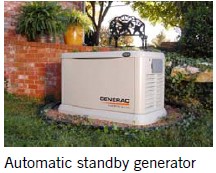
The combined credits for various loss prevention systems can reduce homeowner premium by 30 percent or more.
Agents reported that many families with fine homes, valuable collections, and luxury vehicles fail to take advantage of credits for safety systems such as burglar alarms, water leak detection, and power backup systems. When combined, the credits for various loss prevention systems can reduce homeowner premium by 30 percent or more. For automobiles, safety systems could reduce the comprehensive premium from 5 to 20 percent.
|
Systems that Often Earn Loss Prevention Credits
|
|||||
|---|---|---|---|---|---|
| Home Systems | Automobile Systems | ||||
| Burglar alarms | Theft alarms | ||||
| Fire alarms and sprinkler systems | Fuel cut-off switches | ||||
| Electrical backup, lightning protection | Hood locks | ||||
| Temperature monitoring | Steering locks | ||||
| Water leak detection with auto valve cut-off | Ignition cut-off switches | ||||
| Gas leak detection | Location transponders | ||||
In older homes, rehabilitating the plumbing, electrical, or heating system also helps prevent losses and lower premiums. Each rehabilitated system can earn a premium credit of up to 5 percent, depending on how recently the work was completed.
Finally, installing safety systems reinforces the choice of higher deductibles. When used together, the two strategies can reduce homeowner premium by up to half. Insurance companies such as ACE that cater to HNW families offer such deep discounts for a number of reasons. Families who invest in safety systems and assume more risk for small losses through a higher deductible are more likely to be careful. Consequently, they usually suffer fewer losses, both large and small. It's a win-win outcome for both the client and the company.
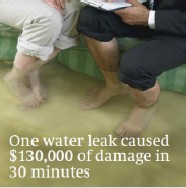
While premium credits reward the installation of loss prevention devices, the real benefit is avoiding costly, disruptive repairs and potential harm to your family.
Consider the Leak Defense System, a device that automatically detects leaks and then shuts off the water supply to minimize damage. It typically costs $2,500 to buy and install and earns a 5 to 7 percent credit on ACE's base homeowner premium. If it helps prevent major damage from just one leak, it pays for itself many times over.
come to $18,900 over 21 years, far outweighing the additional $2,000 paid at the time of the one loss. As the table below shows, the homeowner would come out ahead even if a loss occurred in the third year. The savings can be even greater for a higher value home and a higher deductible.
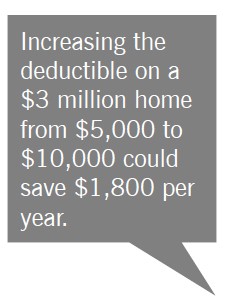
|
Example of Potential Savings with a High Deductible
|
|||||
|---|---|---|---|---|---|
|
$1 Million Home: $2,500 Versus $500 Deductible
|
|||||
| Year # | 1 | 3 | 5 | 10 | 21 |
| Cumulative Premium Savings |
$900 | $2700 | $4500 | $9000 | $18,900 |
| Additional Deductible Paid If Loss Occurs |
$2000 | $2000 | $2000 | $2000 | $2000 |
| Net Cost/Savings | -$1,100 | $700 | $2500 | $7000 | $16,900 |
|
$3 Million Home: $10,000 Versus $5,000 Deductible
|
|||||
| Cumulative Premium Savings |
$1,800 | $5,400 | $9,000 | $18,000 | $37,800 |
| Additional Deductible Paid If Loss Occurs |
$5000 | $5000 | $5000 | $5000 | $5000 |
| Net Cost/Savings | -$3,200 | $400 | $4,000 | $13,000 | $32,800 |
ACE makes the decision even easier with the Deductible Reserve. When a client chooses a homeowners deductible of $2,500 or more, ACE sets aside 10 percent of the deductible amount in a reserve for each claim-free year on the policy. When the client has his or her first claim, ACE applies the reserve against the deductible amount to effectively reduce the out-ofpocket expense. For instance, after five claim-free years with a $2,500 deductible, the reserve would equal $1,250. If the client has a claim in the sixth year, the reserve reduces the deductible payment by half. The same logic holds if the client chooses a deductible of $1,000 or more on his or her auto policy.

Discounts can be 10
percent or higher.
Enticed by promises of savings from heavily advertised auto insurance carriers, even high net worth families can find themselves tempted to place their auto insurance with one company and their homeowners insurance with another. But the apparent savings can be illusory. Spreading the policies across different carriers not only increases the potential for gaps in coverage, it can diminish or negate the package discounts achieved when multiple policies are placed with one carrier. These discounts can be 10 percent or higher.
To maximize the benefits of package discounts, families should choose a carrier that can handle a wide range of needs so that the discount applies across the most insurance policies possible. For instance, ACE Private Risk Services allows the package discount to apply across
Compared to 2010, more agents in 2012 reported that families insured by mass-market carriers were likely missing a variety of savings opportunities. The survey asked about 11 savings opportunities, and the average percent of agents reporting each savings opportunity as likely missed in 2012 was nearly 28 percent, an almost 6-point increase. Responses by savings opportunity ranged widely — from 81 percent for having a deductible that was needlessly low to 9 percent for missing an accident-free credit in their auto insurance.

Families should consider how much they could pay for a loss without significantly affecting their lifestyle, and then ask their agent to estimate the premium savings they could achieve with a range of deductibles up to their maximum amount.
|
Percent of Agents Reporting Savings Opportunity As Likely Overlooked
|
|||
|---|---|---|---|
| 2012 | 2010 | Ppt. Chg. | |
| Deductibles too low | 81% | 78% | + 3 |
| Package discounts | 62% | 55% | + 7 |
| Loss prevention credits — home, car alarms, etc. | 50% | 36% | + 14 |
| Paying low collector car rates for a collector car | 31% | 19% | + 12 |
| New or rehabilitated home credit | 22% | 13% | + 9 |
| Storing infrequently worn jewelry in a bank vault | 20% | 16% | + 4 |
| Good student discount | 11% | 5% | + 6 |
| Credit rating (can it easily be lowered?) | 10% | 5% | + 5 |
| Accident-free credit | 9% | 10% | - 1 |
| Accident prevention course credit | 9% | 6% | + 3 |
| Other | 3% | 3% | 0 |
| Average (excludes "other") | 27.7% | 22.1% | 5.6% |
To help families and their advisors understand the dynamics and potential of the most commonly missed savings opportunities, this white paper offers the following explanations:
Many HNW families insured by mass-market carriers have homeowners and auto insurance policies with deductibles of $250, $500, or $1,000. Ironically, they pay a substantial amount in premium for these low deductibles, but they don't file a claim after a minor accident. They worry their insurance rates will go up, and they can easily afford to pay for repairs entirely out of their own pocket.
Instead, these families should consider how much they could pay for a loss without significantly affecting their lifestyle, and then ask their agent to estimate the premium savings they could achieve with a range of deductibles up to their maximum amount. This process allows them to assess the trade-off between risk and savings. Some of the wealthiest clients insured by ACE select deductibles of $1 million or more.
The savings can be substantial. Using the ACE Platinum Portfolio policy as an example, the annual savings in premium for insuring a $1 million home with a $2,500 deductible versus a $500 deductible could be about $900. So, the homeowner must weigh the risk of paying an additional $2,000 for a loss ($2500 minus $500) against the certainty of saving $900 per year in premium. Since ACE's typical client files a claim for a home only once every 21 years, taking the higher deductible would be the better choice. The total premium savings would.

In Colorado, 64 percent of homeowners affected by the 2010 Fourmile Canyon Wildfire were underinsured by an average of $200,000, according to a survey by United Policyholders, a consumer advocacy group.1
<h1>A Renewed Focus on Proper Protection</h1>
Families with substantial assets overpay to be underinsured primarily because they fail to adjust their personal insurance program as they build wealth. Faced with the complexity of insurance policy contracts and often reluctant to think about bad things that could happen, these families leave their insurance relatively unchanged year after year.
But events of the last few years have brought new urgency to the focus on proper protection. In 2011, the Federal Emergency Management Administration (FEMA) declared 99 federal disasters, up from the record of 81 in 2010 and well above the average of 35 federal disasters per year since 1953.2 In 2011, disasters included Hurricane Irene, heavy flooding in the Midwest, the most damaging wildfire in the history of Texas, a magnitude 5.8 earthquake that cracked the Washington Monument, the deadliest tornado since 1947, and a 'super derecho' — a line of intense thunderstorms that cut a 700-mile swath of destruction from the Midwest to the mid-Atlantic. In 2012, Superstorm Sandy in the Northeast and the Waldo Canyon and High Park fires in Colorado continued to draw attention to the vulnerability of family and home.
While such events impose hardship on both rich and poor, the tendency of wealthy families to have second homes near the beach or in scenic mountain areas makes them especially vulnerable. Many have learned through costly experience about limitations in their insurance policies regarding the cost of replacing their home, the coverage for valuable collections, and the cause of loss, such as sewer and drain backup, earthquake, and flood.
In addition to natural disasters, man-made events have raised the need for proper protection. High levels of financial market volatility have encouraged many high net worth families to step up spending on jewelry, fine art, wine, classic cars and other valuable collections as a means of asset diversification. While this strategy may or may not diminish their vulnerability to market risk, it does expose their asset base to greater levels of physical risk from theft, fire, and other perils.
Finally, considering the weak recovery from the 2008-2009 Great Recession, families with substantial assets have grown more concerned about the general attitude in society towards those at the upper end of the income scale. In a 2011 ACE survey about liability risk among households with $5 million or more in investable assets, 68 percent of respondents felt attitudes toward the wealthy had grown more negative.3 This concern extended to a heightened fear of being hit with a high-stakes liability lawsuit, as opportunistic plaintiffs seek to capitalize on defendants with deep pockets.
With these risks in mind, HNW families and their wealth advisors have a strong reason to look more closely at their personal insurance programs. According to the agents surveyed by ACE, many will be even more likely than they were in 2010 to find significant savings opportunities that can partially or completely offset the cost of stronger protection overall.